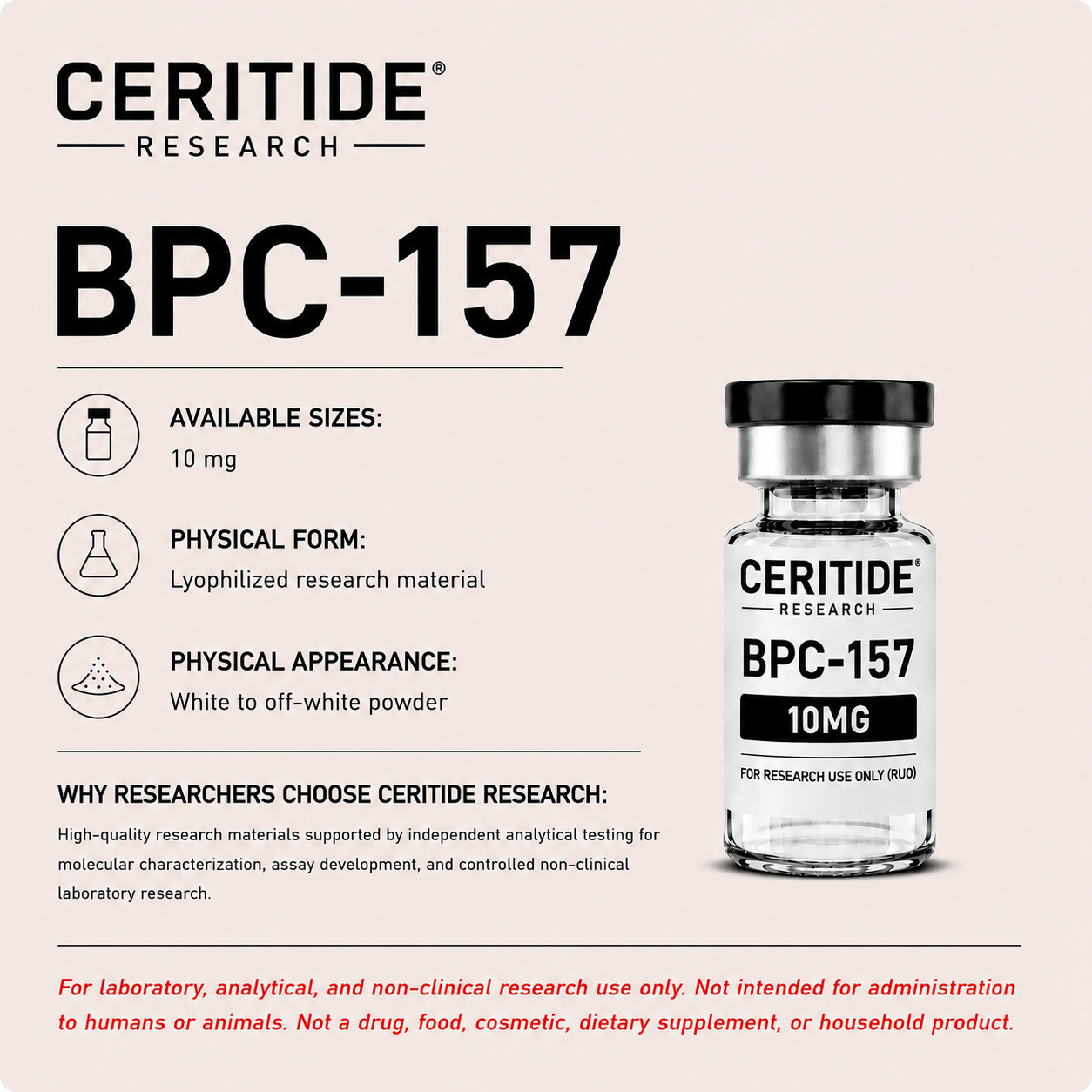
Product specifications are provided for laboratory identification, inventory management, and analytical planning. Available sizes, appearance, packaging, and documentation may vary by lot; researchers should review the applicable product label and lot-specific testing records before use.
- Ceritide Research Product Designation: BPC-157
- Available Sizes: 10 mg
- Physical Form: Lyophilized research material
- Physical Appearance: White to off-white powder
- Packaged Shipping Weight: Approximately 0.2 lb
- Approximate Packaged Dimensions: 4 X 6 inches
- Intended Application: Laboratory, analytical, and non-clinical research
- Regulatory Status:
- Documentation: Lot-specific analytical testing documentation available
Proper storage and controlled handling help protect the identity, integrity, and analytical consistency of laboratory research materials. Storage requirements may vary according to molecular structure, formulation, salt form, packaging, and supplier specifications. Always follow the lot-specific Certificate of Analysis, product label, or accompanying technical documentation when available.
Storage of Lyophilized Research Materials
Recommended Storage: Store unopened lyophilized material under refrigerated or frozen conditions as specified in the corresponding product documentation.
Temperature Control: Minimize unnecessary exposure to room temperature and avoid repeated temperature fluctuations during storage.
Moisture Protection: Keep the vial tightly sealed and protect the contents from humidity, condensation, and direct contact with moisture.
Light Protection: Store away from direct sunlight and strong laboratory lighting when the material is identified as light-sensitive.
Before Opening: Allow a refrigerated or frozen sealed vial to equilibrate to room temperature before opening. This helps reduce condensation inside the container.
Long-Term Storage: For extended storage, follow the temperature range and expiration or retest period stated in the applicable supplier documentation. Do not assume that one storage period applies to every research material.
Storage of Prepared Laboratory Samples
Prepared laboratory samples may have different stability characteristics from the original lyophilized material. Stability can vary according to concentration, solvent system, buffer composition, pH, temperature, container material, and molecular structure.
Laboratory Protocols: Prepare and store samples only according to a validated laboratory method or institutionally approved analytical protocol.
Short-Term Storage: Maintain prepared samples at the temperature specified by the validated method, supplier documentation, or stability data applicable to the compound.
Aliquoting: Where appropriate for the laboratory procedure, divide prepared material into single-analysis aliquots to reduce repeated handling and freeze-thaw exposure.
Freeze-Thaw Control: Avoid repeated freeze-thaw cycles unless the analytical method has demonstrated that they do not affect sample integrity.
Container Handling: Use clean, chemically compatible laboratory containers and minimize unnecessary exposure to air, light, heat, and moisture.
Prepared-sample guidance is provided for analytical workflow planning only and does not constitute directions for administration, dosing, or personal use.
Lot-Specific Storage Information
Storage conditions shown on a Certificate of Analysis, product label, or supplier specification take precedence over general guidance. Researchers should document storage temperature, opening date, preparation conditions, and handling history as part of standard laboratory recordkeeping.
Research Use Only
Ceritide Research materials are supplied solely for laboratory, analytical, and non-clinical research. They are not intended for administration to humans or animals and are not offered as drugs, foods, cosmetics, dietary supplements, medical devices, or household products.
Elige opciones