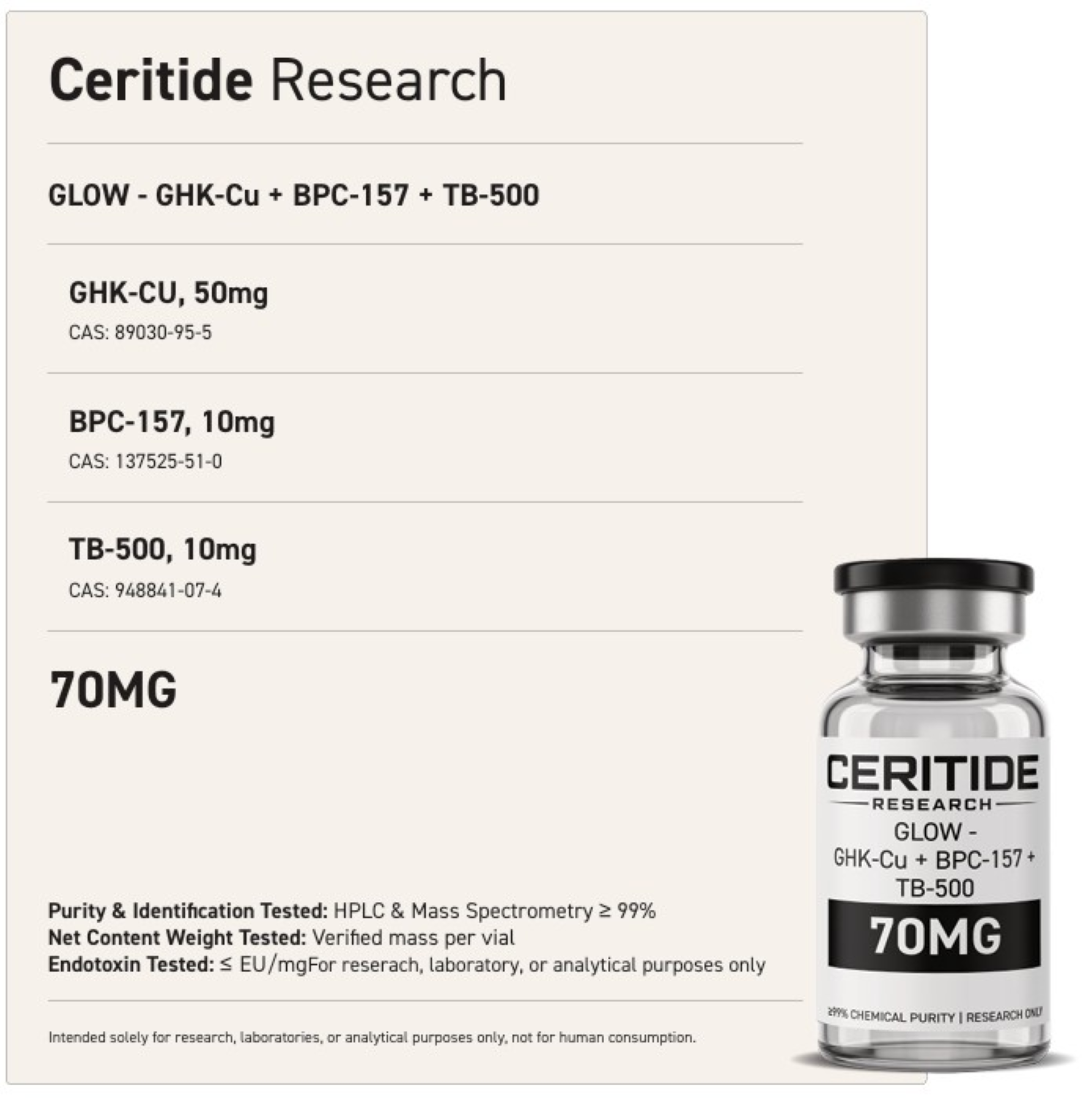
GLOW - GHK-Cu + BPC-157 + TB-500
GLOW es una formulación de investigación sintética desarrollada como una mezcla de compuestos multicomponente destinada a investigaciones analíticas y de laboratorio donde se requieren materiales controlados y bien caracterizados. Diseñado con un enfoque en la consistencia química y la estabilidad de la formulación, GLOW se utiliza en entornos de investigación para estudios que involucran interacciones de compuestos, comportamiento de la formulación y análisis de estructura-función a nivel molecular. Cada componente incluido en la formulación posee una identidad química definida y propiedades fisicoquímicas documentadas, mientras que el producto terminado se clasifica como una formulación en lugar de una entidad molecular única.
- Size: 50/10/10MG
- Form: Lyophilized Powder
- Appearance: Blue powder
- Weight:
- Dimensions: 2" x 2" x 2"
- Chemical Purity: >99%
- Purity & Identification Testing: HPLC & Mass Spectrometry
- Net Content Weight Testing: Milligram Weight
- Endotoxin Testing: < 0% Bacterial Endotoxins
- Regulatory Status: Solo para uso en investigación (RUO)
- Chemical Grade: Laboratory, Research y Analytical

- CAS: 49557-75-7
- Molecular Formula: C₁₄H₂₄CuN₆O₄
- Molecular Weight: 404.9 g/mol
- Amino Length: 3 amino acids
- Classification: GHK-Cu is classified as a copper-binding tripeptide and belongs to the family of regenerative peptides.
- Structure: GHK-Cu is not a linear molecule. Although the peptide backbone (Gly-His-Lys) is linear, the copper ion (Cu²⁺) coordinates with multiple nitrogen atoms in the peptide. This creates chelate rings, forming a stable cyclic coordinated structure around the copper center. The complex typically exhibits square planar geometry.
- Sequence: Gly-His-Lys (G-H-K)
- Synonyms: GHK-Cu, Copper Tripeptide-1, Glycyl-L-Histidyl-L-Lysine Copper, GHK Copper Peptide, Copper peptide GHK-Cu, Tripeptide-1 Copper, GHK Copper Complex
- NIH PubChem: GHK-Cu (PubChem CID: 133697840)
- NIH PubMed Article: GHK-Cu regenerative actions in human skin (Pickart et al., 2018)
- CAS: 137525-51-0
- Molecular Formula: C₆₂H₉₈N₁₆O₂₂
- Molecular Weight: 1,419.53 g/mol
- Amino Length: 15 amino acids
- Classification: BPC-157 is classified as a synthetic stable pentadecapeptide and belongs to the family of cytoprotective research peptides.
- Structure: Linear Pentadecapeptide
- Sequence: Gly-Glu-Pro-Pro-Pro-Gly-Lys-Pro-Ala-Asp-Asp-Ala-Gly-Leu-Val
- Synonyms: BPC-157, Body Protection Compound-157, BPC 157, Stable Gastric Pentadecapeptide BPC 157, PL-14736
- NIH PubChem: BPC-157 (PubChem CID: 9941957)
- NIH PubMed Article: Stable Gastric Pentadecapeptide BPC 157 and Wound Healing (Seiwerth et al., 2021)
- CAS: 137525-51-0
- Molecular Formula: C₃₈H₆₈N₁₀O₁₄
- Molecular Weight: 889.0 g/mol
- Amino Length: 7 amino acids
- Classification: TB-500 is classified as a synthetic stable heptapeptide and belongs to the family of regenerative research peptides derived from Thymosin Beta-4.
- Structure: Linear Heptapeptide
- Sequence: Ac-Leu-Lys-Lys-Thr-Glu-Thr-Gln
- Synonyms: TB-500, TB500, TB500 Frag 17-23, Ac-LKKTETQ, N-acetylated LKKTETQ, Thymosin Beta-4 fragment 17-23
- NIH PubChem: TB-500 (PubChem CID: 62707662)
- NIH PubMed Article: Simultaneous quantification of TB-500 and its metabolites (Rahaman et al., 2024)
Peptide Storage Guidelines: Best Practices for Research Stability
At Ceritide Research, we provide high-purity peptides for laboratory and scientific research. Proper storage preserves peptide integrity and supports reliable experimental results.
Storage Guidelines for Lyophilized (Powder) Peptides
- Long-Term Storage: Keep at -20°C (-4°F) or lower (ideally -80°C / -112°F) for multi-year stability.
- Short-Term Storage: Refrigerate at 2–8°C (36–46°F) for weeks to a few months. Minimize room temperature exposure.
- Best Practices: Store in airtight vials with desiccants. Allow vials to reach room temperature in a desiccator before opening. Protect from light and moisture. Aliquot to reduce freeze-thaw cycles.
Storage Guidelines for Reconstituted Peptide Solutions
Once dissolved, peptides are less stable and should be used promptly:
- Recommended Temperature: Store at 2–8°C (36–46°F) (refrigerator) for short-term use, typically up to 1–4 weeks depending on the sequence and buffer.
- Longer-Term Solution Storage: Aliquot and freeze at -20°C (-4°F) or lower. Avoid storing solutions long-term when possible.
- Best Practices: Use sterile techniques, bacteriostatic water or research-grade buffers, and minimize exposure to air and light. Prevent repeated freeze-thaw cycles.
For Research Use Only
All products from Ceritide Research are sold for research, laboratory, or analytical purposes only, and are not for human consumption. Our peptides are intended exclusively for in vitro scientific research and are not for human or veterinary use.
What peptides are included in GLOW and at what dosages?
What is the difference between GLOW and KLOW?
What research applications is GLOW studied for?
Why does GLOW contain more GHK-Cu than BPC-157 and TB-500?
How is GLOW supplied?
What does the blue color of GLOW indicate?
Does GLOW contain any fillers or excipients?
GLOW - GHK-Cu + BPC-157 + TB-500
Precio de oferta$95.00
Elige opciones
GLOW - GHK-Cu + BPC-157 + TB-500
Precio de oferta$95.00