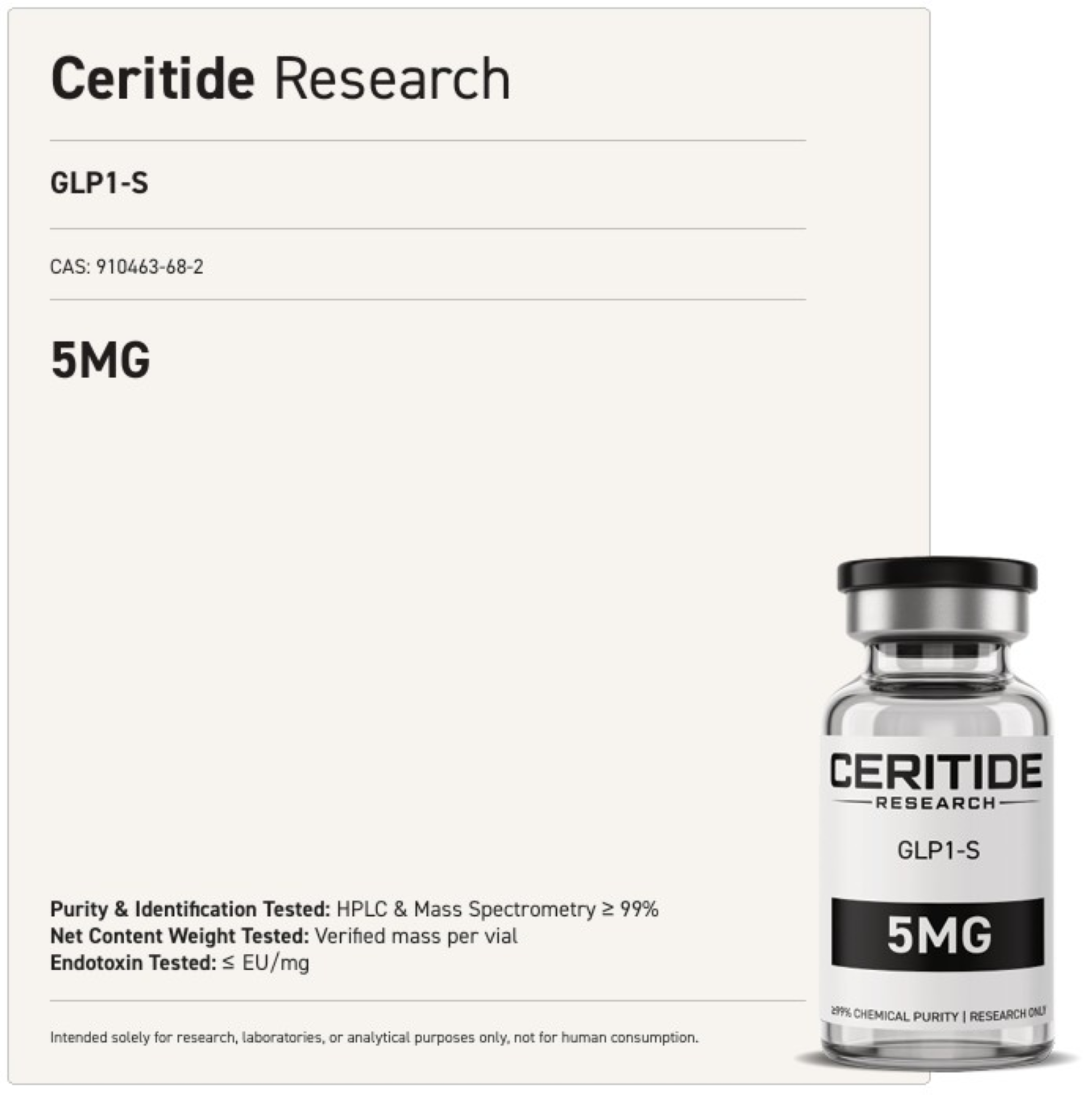
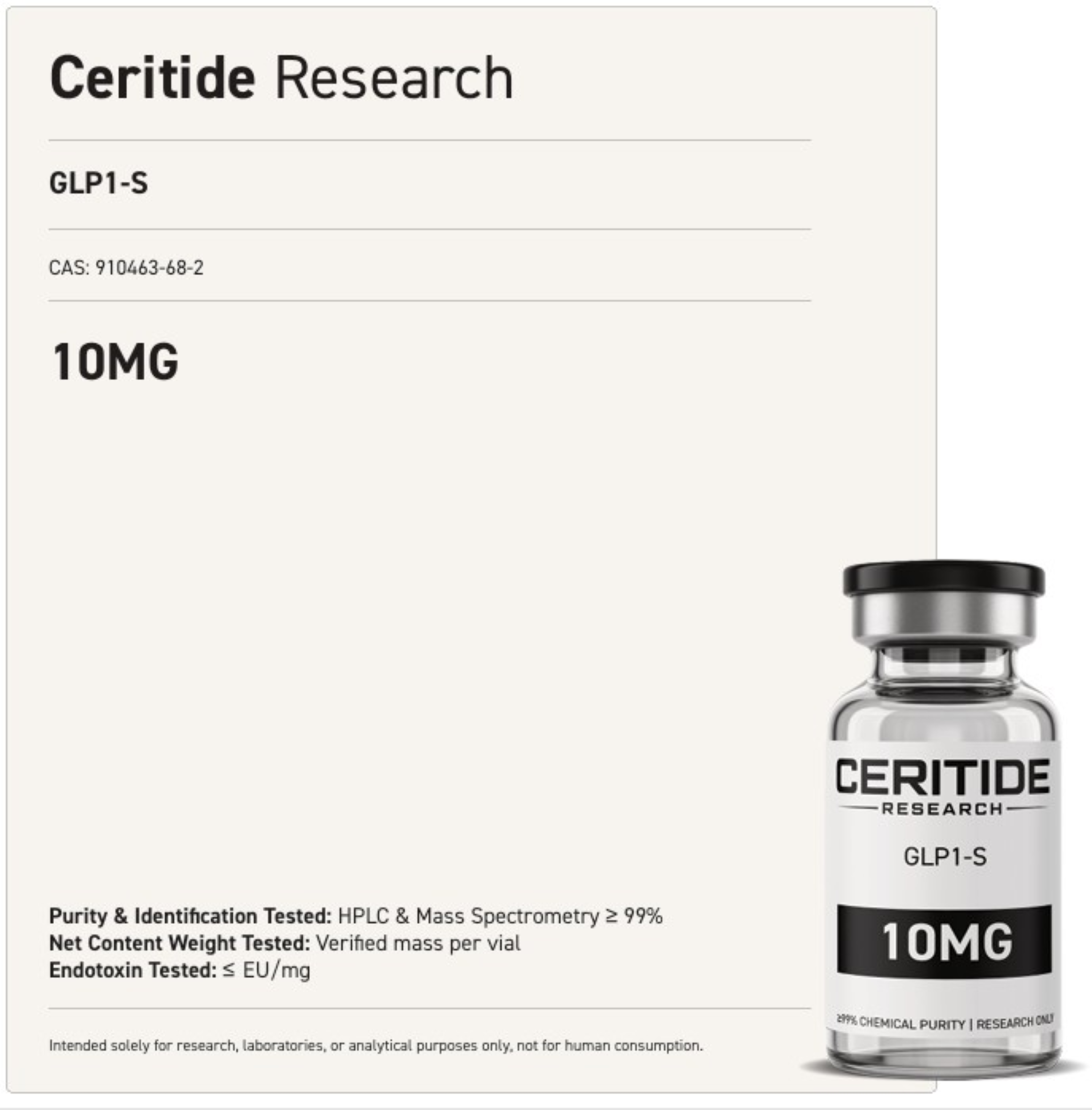
GLP-1S
GLP-1S es un compuesto de investigación peptídico sintético diseñado como un análogo estabilizado del péptido 1 similar al glucagón (GLP-1), una hormona incretina de origen natural involucrada en las vías de señalización metabólica. Diseñado con modificaciones de secuencia para mejorar la estabilidad estructural para la manipulación en laboratorio, GLP-1S retiene una composición de aminoácidos definida y una identidad molecular bien caracterizada, lo que lo hace adecuado para el análisis de la estructura-función de péptidos, estudios de unión a receptores e investigación de señalización endocrina. Con propiedades fisicoquímicas documentadas y síntesis reproducible.
- Size: 5MG, 10MG
- Form: Lyophilized Powder
- Appearance: White to off-white powder
- Weight:
- Dimensions: 2" x 2" x 2"
- Chemical Purity: >99%
- Purity & Identification Testing: HPLC & Mass Spectrometry
- Net Content Weight Testing: Milligram Weight
- Endotoxin Testing: < 0% Bacterial Endotoxins
- Regulatory Status: Solo para uso en investigación (RUO)
- Chemical Grade: Laboratory, Research y Analytical
- Ceritide Research Product Designation: GLP-1S
- Scientific Compound: Semaglutide
- Development Identifier: NN9535
- CAS Number: 910463-68-2
- Molecular Formula: C₁₈₇H₂₉₁N₄₅O₅₉
- Molecular Weight: 4.113,64 g/mol
- Amino-Acid Length: 30-31 aminoácidos
- Classification: Péptido sintético
- Structure: A synthetic, linear and acylated 31-residue peptide analog of human GLP-1. It contains an alanine-to-2-aminoisobutyric-acid, or Aib, substitution at position 8 and a lysine-to-arginine substitution at position 34. The lysine residue at position 26 is conjugated through a γ-glutamic-acid and hydrophilic spacer containing two OEG units to a C18 fatty diacid. The peptide terminates with a C-terminal glycine carboxylic acid and is not C-terminally amidated.
- Sequence: Análogo de GLP-1 modificado
- Common Identifiers: Semaglutide; NN9535; NNC 0113-0217
- NIH PubChem: Semaglutide, PubChem CID 56843331
- NIH PubMed Article: “Discovery of the Once-Weekly Glucagon-Like Peptide-1 (GLP-1) Analogue Semaglutide” — Lau J, Bloch P, Schäffer L, et al., published September 24, 2015
- NIH PubMed Article: “The Discovery and Development of Liraglutide and Semaglutide” — Knudsen LB and Lau J, published April 12, 2019
Peptide Storage Guidelines: Best Practices for Research Stability
At Ceritide Research, we provide high-purity peptides for laboratory and scientific research. Proper storage preserves peptide integrity and supports reliable experimental results.
Storage Guidelines for Lyophilized (Powder) Peptides
- Long-Term Storage: Keep at -20°C (-4°F) or lower (ideally -80°C / -112°F) for multi-year stability.
- Short-Term Storage: Refrigerate at 2–8°C (36–46°F) for weeks to a few months. Minimize room temperature exposure.
- Best Practices: Store in airtight vials with desiccants. Allow vials to reach room temperature in a desiccator before opening. Protect from light and moisture. Aliquot to reduce freeze-thaw cycles.
Storage Guidelines for Reconstituted Peptide Solutions
Once dissolved, peptides are less stable and should be used promptly:
- Recommended Temperature: Store at 2–8°C (36–46°F) (refrigerator) for short-term use, typically up to 1–4 weeks depending on the sequence and buffer.
- Longer-Term Solution Storage: Aliquot and freeze at -20°C (-4°F) or lower. Avoid storing solutions long-term when possible.
- Best Practices: Use sterile techniques, bacteriostatic water or research-grade buffers, and minimize exposure to air and light. Prevent repeated freeze-thaw cycles.
For Research Use Only
All products from Ceritide Research are sold for research, laboratory, or analytical purposes only, and are not for human consumption. Our peptides are intended exclusively for in vitro scientific research and are not for human or veterinary use.
Elige opciones
GLP-1S
Precio de oferta$45.00