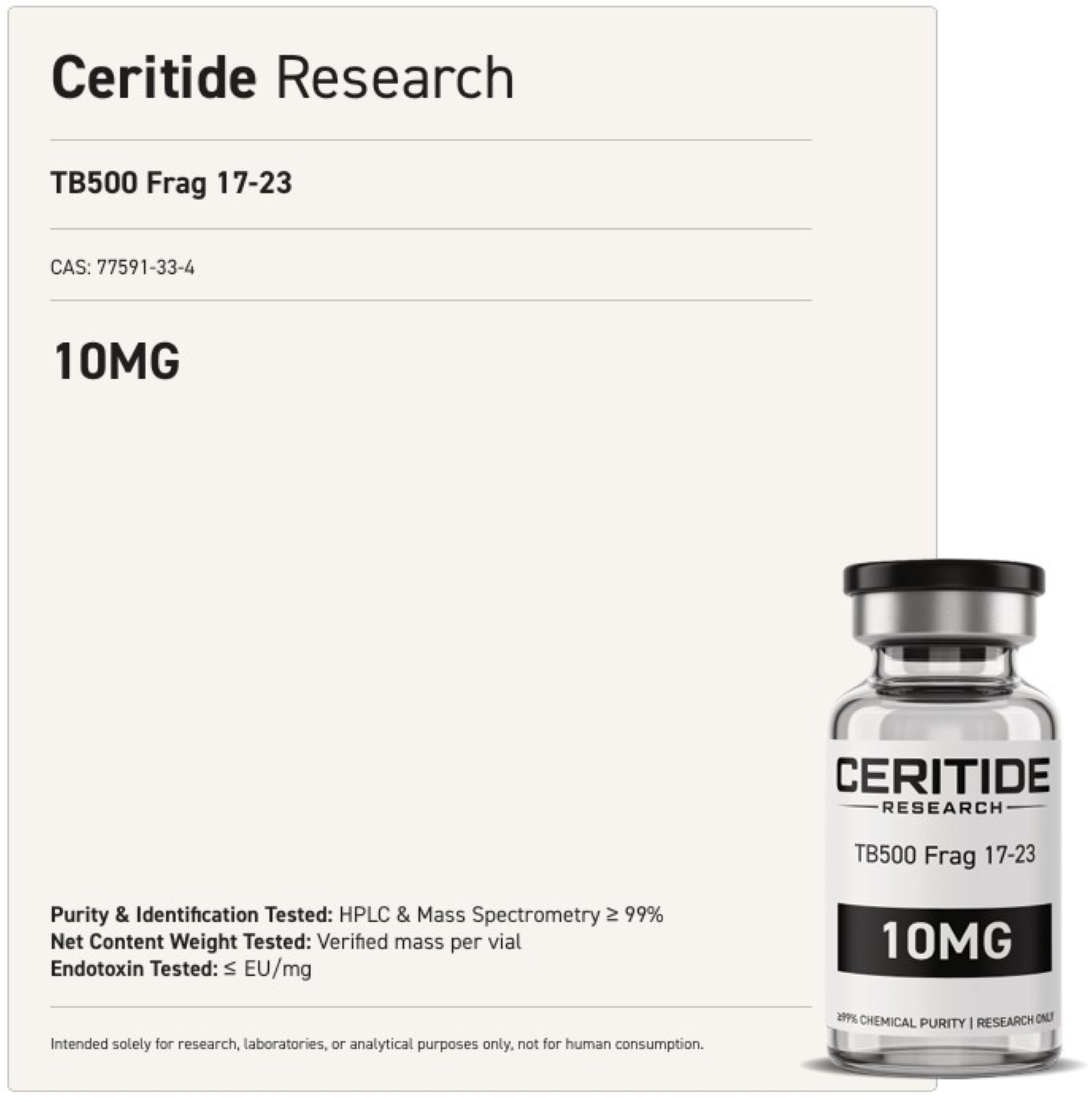
Fragmento TB500 17-23
El fragmento 17-23 de TB-500 es un fragmento peptídico corto sintético derivado de una secuencia específica de siete aminoácidos dentro del péptido TB-500 más grande, que a su vez se origina en la timosina beta-4. Este fragmento se caracteriza por una secuencia de aminoácidos primaria definida y un bajo peso molecular, lo que permite estudiarlo independientemente del compuesto parental de longitud completa en investigaciones de estructura-función de péptidos e interacción molecular. El fragmento 17-23 de TB-500 se menciona comúnmente en la literatura científica para investigaciones centradas en el comportamiento de los fragmentos peptídicos, la actividad secuencia-específica y el análisis comparativo con péptidos derivados de timosina más largos.
- Size: 10MG
- Form: Lyophilized Powder
- Appearance: White to off-white powder
- Weight:
- Dimensions: 2" x 2" x 2"
- Chemical Purity: >99%
- Purity & Identification Testing: HPLC & Mass Spectrometry
- Net Content Weight Testing: Milligram Weight
- Endotoxin Testing: < 0% Bacterial Endotoxins
- Regulatory Status: Solo para uso en investigación (RUO)
- Chemical Grade: Laboratory, Research y Analytical
- CAS: 885340-08-9
- Molecular Formula: C₃₈H₆₈N₁₀O₁₄
- Molecular Weight: 889.02 g/mol
- Amino Length: 7 Aminoácidos
- Classification: TB-500 is classified as a synthetic stable heptapeptide and belongs to the family of regenerative research peptides derived from Thymosin Beta-4.
- Structure: Linear peptide with N-terminal acetylation
- Sequence: Ac-LKKTETQ (N-acetyl-L-leucyl-L-lysyl-L-lysyl-L-threonyl-L-glutamyl-L-threonyl-L-glutamine)
- Synonyms: TB-500, TB500, TB 500, Thymosin β4 (17-23), Ac-LKKTETQ
- NIH PubChem: TB-500 NIH (PubChem: CID 62707662)
- NIH PubMed Article: Synthesis and characterization of the N-terminal acetylated 17-23 fragment of thymosin beta 4 identified in TB-500, a product suspected to possess doping potential – Esposito et al., 2012
Peptide Storage Guidelines: Best Practices for Research Stability
At Ceritide Research, we provide high-purity peptides for laboratory and scientific research. Proper storage preserves peptide integrity and supports reliable experimental results.
Storage Guidelines for Lyophilized (Powder) Peptides
- Long-Term Storage: Keep at -20°C (-4°F) or lower (ideally -80°C / -112°F) for multi-year stability.
- Short-Term Storage: Refrigerate at 2–8°C (36–46°F) for weeks to a few months. Minimize room temperature exposure.
- Best Practices: Store in airtight vials with desiccants. Allow vials to reach room temperature in a desiccator before opening. Protect from light and moisture. Aliquot to reduce freeze-thaw cycles.
Storage Guidelines for Reconstituted Peptide Solutions
Once dissolved, peptides are less stable and should be used promptly:
- Recommended Temperature: Store at 2–8°C (36–46°F) (refrigerator) for short-term use, typically up to 1–4 weeks depending on the sequence and buffer.
- Longer-Term Solution Storage: Aliquot and freeze at -20°C (-4°F) or lower. Avoid storing solutions long-term when possible.
- Best Practices: Use sterile techniques, bacteriostatic water or research-grade buffers, and minimize exposure to air and light. Prevent repeated freeze-thaw cycles.
For Research Use Only
All products from Ceritide Research are sold for research, laboratory, or analytical purposes only, and are not for human consumption. Our peptides are intended exclusively for in vitro scientific research and are not for human or veterinary use.
Fragmento TB500 17-23
Precio de oferta$40.00
Elige opciones
Fragmento TB500 17-23
Precio de oferta$40.00