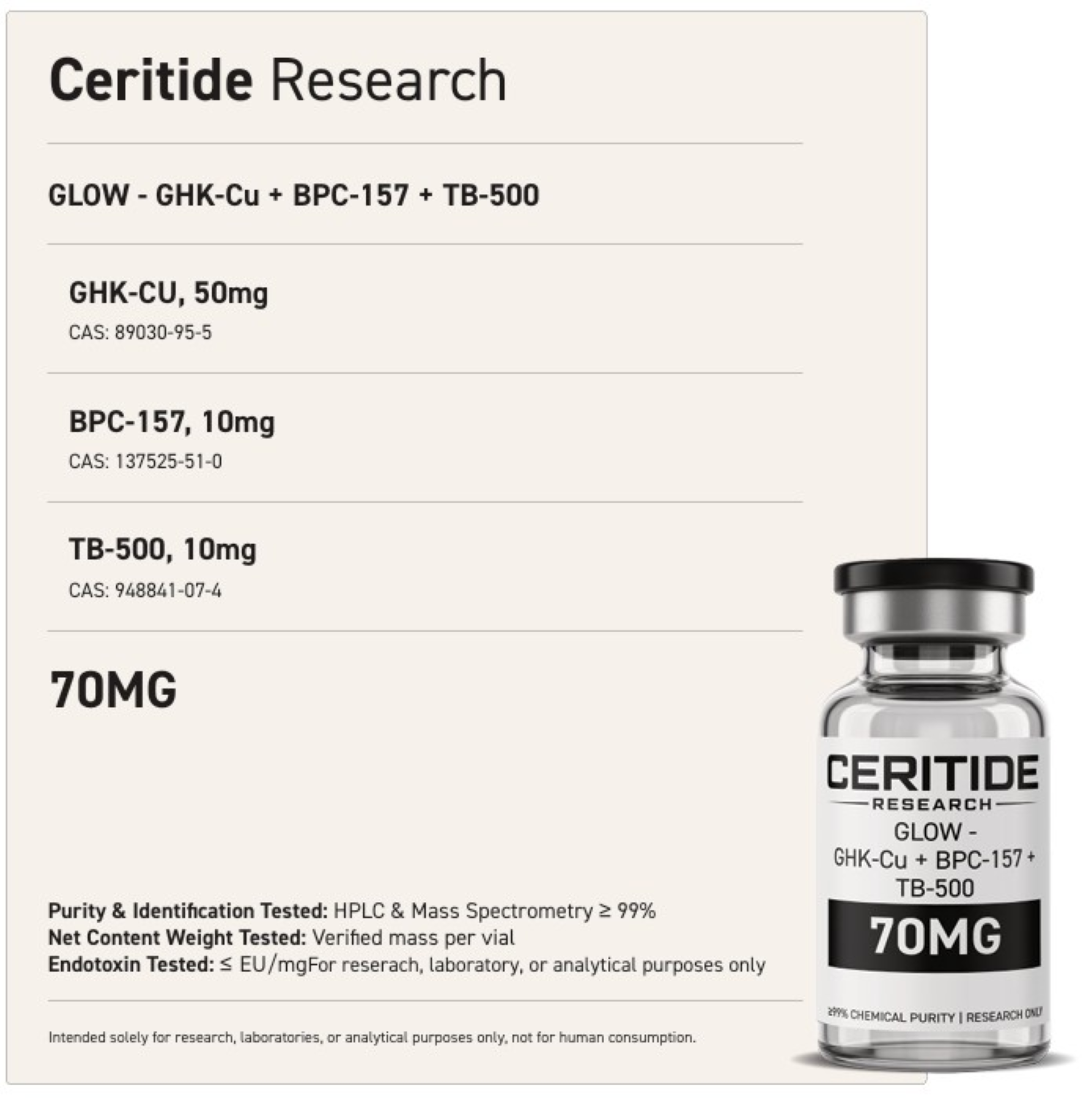
GLOW - GHK-Cu + BPC-157 + TB-500
Glow Blend is a cosmetic and topical research formulation combining GHK-Cu (glycyl-L-histidyl-L-lysine copper complex) with KPV and additional skin-supporting peptides in a synergistic high-purity blend. This advanced formulation is studied in laboratory models for its potential roles in collagen synthesis, antioxidant activity, wound healing, and skin rejuvenation pathways. Characterized by its defined peptide components and copper-complexed structure, Glow Blend is widely referenced in scientific literature for peptide structure–function analysis, extracellular matrix remodeling, and investigations into anti-aging, pigmentation, and barrier function research.
Researchers value Glow Blend for its multi-peptide synergy that enhances fibroblast activity, reduces oxidative stress, and promotes visible skin glow in controlled experimental settings. Its topical-ready composition provides an ideal tool for studying cosmetic formulation development and regenerative dermatology pathways.
Ceritide Research offers GLOW Blend as a premium lyophilized research peptide combining 50mg GHK-Cu, 10mg BPC-157, and 10mg TB-500 with verified ≥99% purity by independent HPLC and mass spectrometry. Supplied in a sterile vial ready for reconstitution, this product delivers reliability top labs demand.
The Purest Peptides. Period.
Research Use Only. Not for human or veterinary use.
- Size: 50/10/10MG
- Form: Lyophilized Powder
- Appearance: Blue powder
- Weight:
- Dimensions: 2" x 2" x 2"
- Chemical Purity: >99%
- Purity & Identification Testing: HPLC & Mass Spectrometry
- Net Content Weight Testing: Milligram Weight
- Endotoxin Testing: < 0% Bacterial Endotoxins
- Regulatory Status: Research Use Only (RUO)
- Chemical Grade: Laboratory, Research, and Analytical
%20with%20KPV%20and%20additional%20skin-supporting%20peptides%20in%20a%20synergistic%20high-purity%20...)
- CAS: 49557-75-7
- Molecular Formula: C₁₄H₂₄CuN₆O₄
- Molecular Weight: 404.9 g/mol
- Amino Length: 3 amino acids
- Classification: GHK-Cu is classified as a copper-binding tripeptide and belongs to the family of regenerative peptides.
- Structure: GHK-Cu is not a linear molecule. Although the peptide backbone (Gly-His-Lys) is linear, the copper ion (Cu²⁺) coordinates with multiple nitrogen atoms in the peptide. This creates chelate rings, forming a stable cyclic coordinated structure around the copper center. The complex typically exhibits square planar geometry.
- Sequence: Gly-His-Lys (G-H-K)
- Synonyms: GHK-Cu, Copper Tripeptide-1, Glycyl-L-Histidyl-L-Lysine Copper, GHK Copper Peptide, Copper peptide GHK-Cu, Tripeptide-1 Copper, GHK Copper Complex
- NIH PubChem: GHK-Cu (PubChem CID: 133697840)
- NIH PubMed Article: GHK-Cu regenerative actions in human skin (Pickart et al., 2018)
- CAS: 137525-51-0
- Molecular Formula: C₆₂H₉₈N₁₆O₂₂
- Molecular Weight: 1,419.53 g/mol
- Amino Length: 15 amino acids
- Classification: BPC-157 is classified as a synthetic stable pentadecapeptide and belongs to the family of cytoprotective research peptides.
- Structure: Linear Pentadecapeptide
- Sequence: Gly-Glu-Pro-Pro-Pro-Gly-Lys-Pro-Ala-Asp-Asp-Ala-Gly-Leu-Val
- Synonyms: BPC-157, Body Protection Compound-157, BPC 157, Stable Gastric Pentadecapeptide BPC 157, PL-14736
- NIH PubChem: BPC-157 (PubChem CID: 9941957)
- NIH PubMed Article: Stable Gastric Pentadecapeptide BPC 157 and Wound Healing (Seiwerth et al., 2021)
- CAS: 137525-51-0
- Molecular Formula: C₃₈H₆₈N₁₀O₁₄
- Molecular Weight: 889.0 g/mol
- Amino Length: 7 amino acids
- Classification: TB-500 is classified as a synthetic stable heptapeptide and belongs to the family of regenerative research peptides derived from Thymosin Beta-4.
- Structure: Linear Heptapeptide
- Sequence: Ac-Leu-Lys-Lys-Thr-Glu-Thr-Gln
- Synonyms: TB-500, TB500, TB500 Frag 17-23, Ac-LKKTETQ, N-acetylated LKKTETQ, Thymosin Beta-4 fragment 17-23
- NIH PubChem: TB-500 (PubChem CID: 62707662)
- NIH PubMed Article: Simultaneous quantification of TB-500 and its metabolites (Rahaman et al., 2024)
Peptide Storage Guidelines: Best Practices for Research Stability
At Ceritide Research, we provide high-purity peptides for laboratory and scientific research. Proper storage preserves peptide integrity and supports reliable experimental results.
Storage Guidelines for Lyophilized (Powder) Peptides
- Long-Term Storage: Keep at -20°C (-4°F) or lower (ideally -80°C / -112°F) for multi-year stability.
- Short-Term Storage: Refrigerate at 2–8°C (36–46°F) for weeks to a few months. Minimize room temperature exposure.
- Best Practices: Store in airtight vials with desiccants. Allow vials to reach room temperature in a desiccator before opening. Protect from light and moisture. Aliquot to reduce freeze-thaw cycles.
Storage Guidelines for Reconstituted Peptide Solutions
Once dissolved, peptides are less stable and should be used promptly:
- Recommended Temperature: Store at 2–8°C (36–46°F) (refrigerator) for short-term use, typically up to 1–4 weeks depending on the sequence and buffer.
- Longer-Term Solution Storage: Aliquot and freeze at -20°C (-4°F) or lower. Avoid storing solutions long-term when possible.
- Best Practices: Use sterile techniques, bacteriostatic water or research-grade buffers, and minimize exposure to air and light. Prevent repeated freeze-thaw cycles.
For Research Use Only
All products from Ceritide Research are sold for research, laboratory, or analytical purposes only, and are not for human consumption. Our peptides are intended exclusively for in vitro scientific research and are not for human or veterinary use.
What peptides are included in GLOW and at what dosages?
What is the difference between GLOW and KLOW?
What research applications is GLOW studied for?
Why does GLOW contain more GHK-Cu than BPC-157 and TB-500?
How is GLOW supplied?
What does the blue color of GLOW indicate?
Does GLOW contain any fillers or excipients?
Choose options