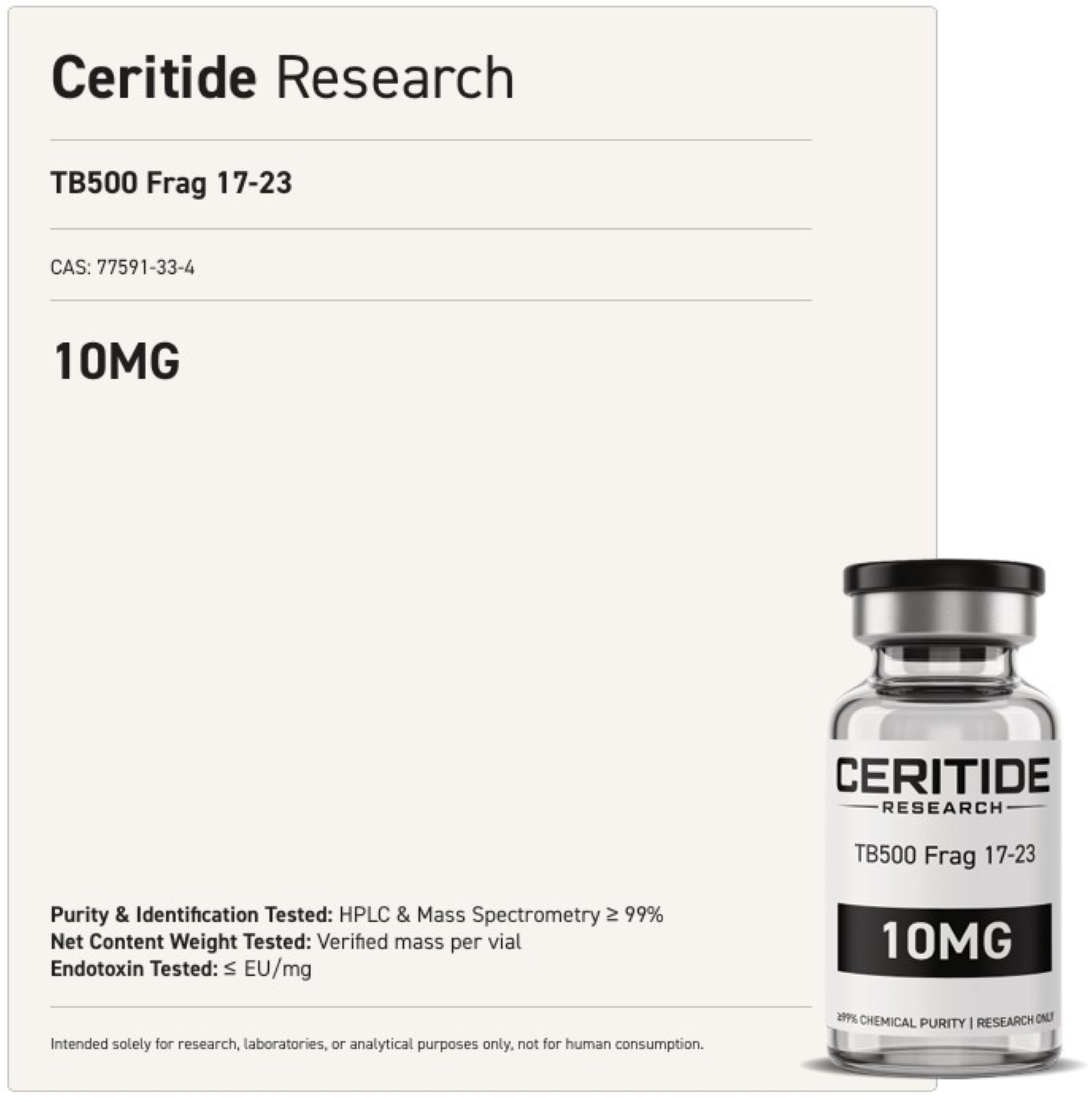
TB-500 Frag 17-23
TB-500 Frag 17-23 is a synthetic heptapeptide fragment derived from the active domain of Thymosin Beta-4 (TB-4), specifically residues 17-23. This linear sequence is studied in laboratory models for its potential roles in actin sequestration, cell migration, angiogenesis, and tissue remodeling. Characterized by its defined amino-acid composition and high stability, TB-500 Frag 17-23 is widely referenced in scientific literature for peptide structure–function analysis, cytoskeletal dynamics, and regenerative pathway research.
Researchers value TB-500 Frag 17-23 for its ability to promote localized wound healing, reduce inflammation, and support extracellular matrix organization in controlled experimental settings. Its short heptapeptide length provides enhanced tissue penetration and selectivity compared to full-length TB-4, making it an ideal tool for investigating actin-binding mechanisms and regenerative responses without systemic effects.
Ceritide Research offers TB-500 Frag 17-23 as a premium 10mg lyophilized research peptide with verified ≥99% purity confirmed by independent HPLC and mass spectrometry. Supplied in a sterile vial and ready for immediate reconstitution per your protocol, this product delivers the reliability top research labs demand.
The Purest Peptides. Period.
Research Use Only. Not for human or veterinary use.
- Size: 10MG
- Form: Lyophilized Powder
- Appearance: White to off-white powder
- Weight:
- Dimensions: 2" x 2" x 2"
- Chemical Purity: >99%
- Purity & Identification Testing: HPLC & Mass Spectrometry
- Net Content Weight Testing: Milligram Weight
- Endotoxin Testing: < 0% Bacterial Endotoxins
- Regulatory Status: Research Use Only (RUO)
- Chemical Grade: Laboratory, Research, and Analytical
- CAS: 885340-08-9
- Molecular Formula: C₃₈H₆₈N₁₀O₁₄
- Molecular Weight: 889.02 g/mol
- Amino Length: 7 amino acids (heptapeptide)
- Classification: TB-500 is classified as a synthetic stable heptapeptide and belongs to the family of regenerative research peptides derived from Thymosin Beta-4.
- Structure: Linear peptide with N-terminal acetylation
- Sequence: Ac-LKKTETQ (N-acetyl-L-leucyl-L-lysyl-L-lysyl-L-threonyl-L-glutamyl-L-threonyl-L-glutamine)
- Synonyms: TB-500, TB500, TB 500, Thymosin β4 (17-23), Ac-LKKTETQ
- NIH PubChem: TB-500 NIH (PubChem: CID 62707662)
- NIH PubMed Article: Synthesis and characterization of the N-terminal acetylated 17-23 fragment of thymosin beta 4 identified in TB-500, a product suspected to possess doping potential – Esposito et al., 2012
Peptide Storage Guidelines: Best Practices for Research Stability
At Ceritide Research, we provide high-purity peptides for laboratory and scientific research. Proper storage preserves peptide integrity and supports reliable experimental results.
Storage Guidelines for Lyophilized (Powder) Peptides
- Long-Term Storage: Keep at -20°C (-4°F) or lower (ideally -80°C / -112°F) for multi-year stability.
- Short-Term Storage: Refrigerate at 2–8°C (36–46°F) for weeks to a few months. Minimize room temperature exposure.
- Best Practices: Store in airtight vials with desiccants. Allow vials to reach room temperature in a desiccator before opening. Protect from light and moisture. Aliquot to reduce freeze-thaw cycles.
Storage Guidelines for Reconstituted Peptide Solutions
Once dissolved, peptides are less stable and should be used promptly:
- Recommended Temperature: Store at 2–8°C (36–46°F) (refrigerator) for short-term use, typically up to 1–4 weeks depending on the sequence and buffer.
- Longer-Term Solution Storage: Aliquot and freeze at -20°C (-4°F) or lower. Avoid storing solutions long-term when possible.
- Best Practices: Use sterile techniques, bacteriostatic water or research-grade buffers, and minimize exposure to air and light. Prevent repeated freeze-thaw cycles.
For Research Use Only
All products from Ceritide Research are sold for research, laboratory, or analytical purposes only, and are not for human consumption. Our peptides are intended exclusively for in vitro scientific research and are not for human or veterinary use.
Choose options